
We are thrilled to present an overview of a thought-provoking new paper recently published in Nature Reviews Materials, titled „Bridging theory and experiment in defect-tolerant semiconductors for photovoltaics„, which delves into the pivotal concept of defect tolerance in photovoltaics.
The research explores the complexities of semiconductors such as lead-halide perovskites, which perform well despite not relying on single-crystalline growth.
Defect tolerance is not just the absence of defects; it is about minimizing their impact on minority carrier lifetimes, which is crucial for solar cell efficiency. The paper explores whether defect tolerance alone accounts for the exceptional performance of lead-halide perovskite-based solution-processed solar cells, or whether other factors also play a role. While the superior performance of these materials remains a subject of debate, defect tolerance has been suggested by experiments and, in certain cases, proven across various semiconductor structures and materials. This Perspective piece examines defect tolerance through the lenses of materials science, defect characterization, and computational modelling. It systematically compares computational and experimental results, aiming to address the complexities arising from diverse theoretical approaches and the varied interpretations of experimental findings, ranging from defect signals to ion migration. The researchers aim to navigate these complexities and establish a rigorous framework for identifying and quantitatively assessing defect tolerance.
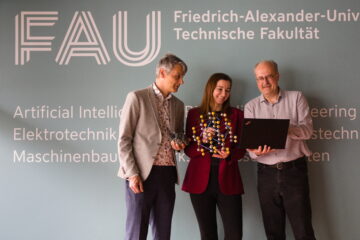
We are proud to acknowledge the remarkable contributions of three eminent professors from the International Research Training Group 2495: Prof. Dr. Christoph J. Brabec, Prof. Dr. Bernd Meyer, and Prof. Dr. Wolfgang Heiss. Their dedication and expertise have been integral to the achievements highlighted in the paper.
Congratulations to the authors and the entire research team on this exceptional contribution to the understanding of defect tolerance in materials science.
For more information, you can access the full paper here